PHUSE US Connect 2026

22nd to 26th March 2026

Austin, Texas
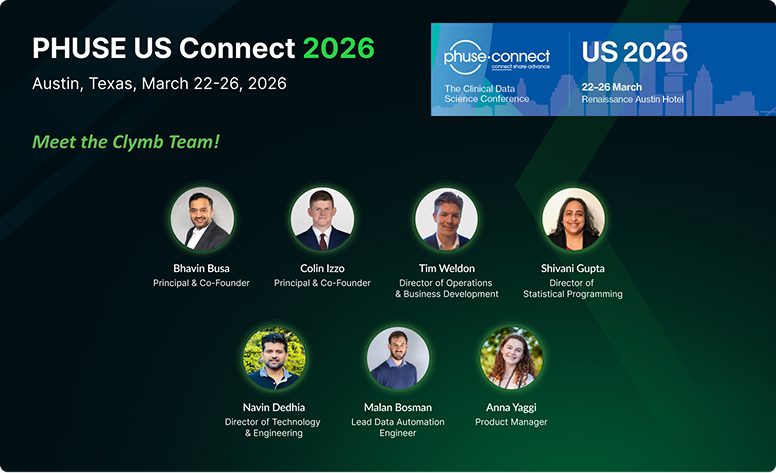
Join the Clymb Team at PHUSE US Connect 2026!
PHUSE US Connect 2026 in Austin, Texas, is set to be one of the largest and most dynamic clinical data science events of the year. Across five days of workshops, technical sessions, hands-on demonstrations and interactive discussions, PHUSE will bring together statisticians, programmers, data scientists, regulatory experts, researchers, and thought leaders from around the world.
1. CDISC ARS Template Code: Gearing Up with Automation in TFL Programming
Date & Time: 24 March, 3:00 PM
Presenters: Anna Yaggi and Malan Bosman
Explore how the CDISC Analysis Results Standard (ARS) is enabling a new era of metadata-driven TFL automation. By generating results through Analysis Results Datasets (ARDs) and leveraging the “Analysis Method Code” concept, what Richard Marshall describes as “Gear 5”, teams can standardize analysis methods and drive them directly from ARS metadata.
This session will highlight how R packages such as cards and cardx support this approach with efficient, template-based functions designed for ARS workflows. Learn how these tools work together to create dynamic, reliable, and scalable automation for TFL generation.
2. AI Code Generator: Automating TFL Programming with ARS Metadata
Date & Time: 23 March, 4:00 PM
Presenters: Navin Dedhia and Bhavin Busa
See how AI is reshaping the way TFL programs are built. Leveraging ARS metadata within TFL Designer, the AI Code Generator uses LLM/GenAI capabilities to produce production-ready SAS and R code in minutes, reducing manual effort and accelerating delivery.
This session will feature a live case study demonstrating how table programs can be generated, refined, and applied to study data to produce outputs, offering a faster, more efficient approach to TFL development.
3. Leveraging CDISC CORE for Proactive SDTM Compliance and Submission Readiness
Date & Time: 25 March, 11:30 AM
Presenter: Shivani Gupta
Learn how integrating the CDISC Open Rules Engine (CORE) directly into the SAS programming workflow can transform SDTM development. By running compliance checks as each domain is built, rather than waiting until the end, we were able to catch issues earlier, reduce rework, and strengthen overall data quality.
This session will share our experience embedding CORE into day-to-day development, compare per-domain versus study-level validation outcomes, and discuss how early checks accelerate timelines and promote a compliance-first mindset. We’ll also highlight the transparency, flexibility, and cost benefits of CORE, offering a practical and scalable approach for teams preparing data for regulatory submission.
4. Automated Code Generation – Evaluating Deterministic and Probabilistic Approaches
Date & Time: 23 March, 12:00 PM
Presenter: Malan Bosman
The clinical development landscape is evolving quickly! With new CDISC standards like ARS, expanding open-source ecosystems, modern technology platforms, and the rise of GenAI. As the industry shifts, teams are exploring how these capabilities can drive faster, more cost-effective, and higher-quality ways of generating TFL programs.
This session breaks down two key approaches to automated code generation: Deterministic, where defined logic produces consistent results, and Probabilistic, where GenAI models introduce flexibility and variation. Through demonstrations of each method, we’ll compare their strengths, limitations, and ideal use cases, offering a balanced view of how both approaches can fit into modern clinical programming workflows.
5. The AI Reckoning: Why Statistical Programmers Must Evolve Now
Date & Time: 23 March, 2:30 PM
Presenter: Bhavin Busa
SAS and R programming are not going away; they will remain foundational to statistical programming. However, the role of the statistical programmer is rapidly evolving as artificial intelligence (AI) and commercially off-the-shelf (COTS) tools reshape day-to-day workflows.
This session explores why the future demands programmers who can integrate large language models (LLMs) into standards-driven solutions that maintain compliance, consistency, and scalability. CDISC standards play a critical role in enabling this transformation. Models such as the Unified Study Design Model (USDM) and the Analysis Results Standard (ARS) are already supporting AI-driven automation for SDTM and ADaM mapping and accelerating TFL development.

Accelerate Clinical Trials with Data-driven Insights
Get in Touch

Thank you!
Your message has been received and we will be contacting you shortly to follow-up.