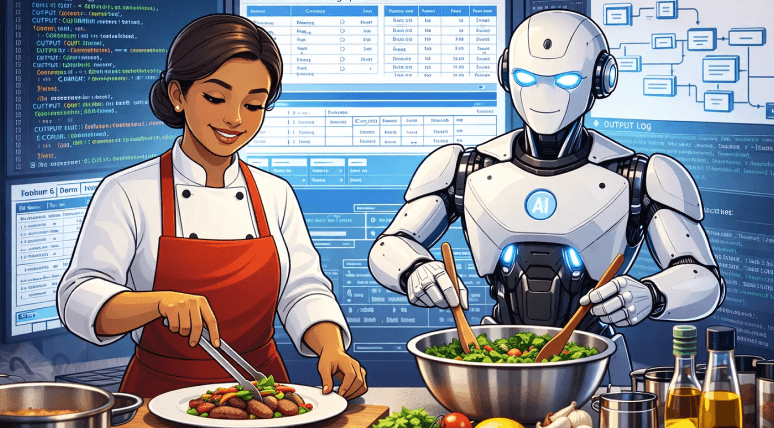
These days everyone wants to add a little AI tadka* into their daily work, and at my job, we’re no different. Just a few months ago, what I now lovingly call “the stone age”, we were still making Excel sheets, listing out program names, hunting for unique and duplicates, and building our TFL lists one line at a time. And there I was, staring at a shell like I’m trying to name a new dish on the menu.
But now? AI walks into the kitchen like a sous-chef who never gets tired, never complains, and always shows up on time. It looks at the shell title, calmly picks a clean program name, and even whips up the code using our Clymb Macro Deck. All I have to do is taste it- oh sorry, review it, adjust whatever doesn’t suit my flavor, and run it. Turbo-speed TFLs, just like pressure-cooker cooking.
So, what’s the magic masala behind this transformation?
It’s our AI Code Generator, an add-on to the TFL Designer. We’ve trained it with all the rules we normally shout across the kitchen: keep program names under 20 characters, call the Big-N macro when needed, follow every standard we’ve drilled into it. These guardrails make sure it behaves, gives consistent output, and uses the macros we’ve lovingly crafted, just like following a family recipe that never fails and always tastes like home.
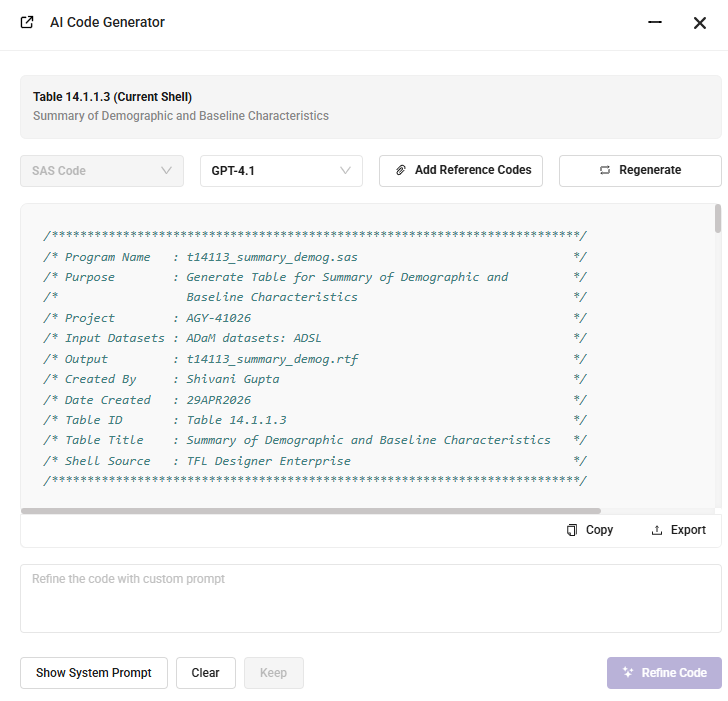
Figure: SAS code generated from AI Code Generator.
Does it give reliable results every time? Yes.
Is it magic?
It’s the hard work of AI engineers, R wizards, and SAS cooks all stirring the pot together to get the perfect outcome. But the most important ingredient, the base gravy of this entire recipe, is the CDISC ARS metadata.
Let me start from the beginning.
Clymb has this wonderful tool called the TFL Designer, our main dish. Then AI walks in like the cocky sous-chef it is, looks at the dish, and decides to create a side dish called the AI Code Generator. (Yes, it named itself. It has that personality.)
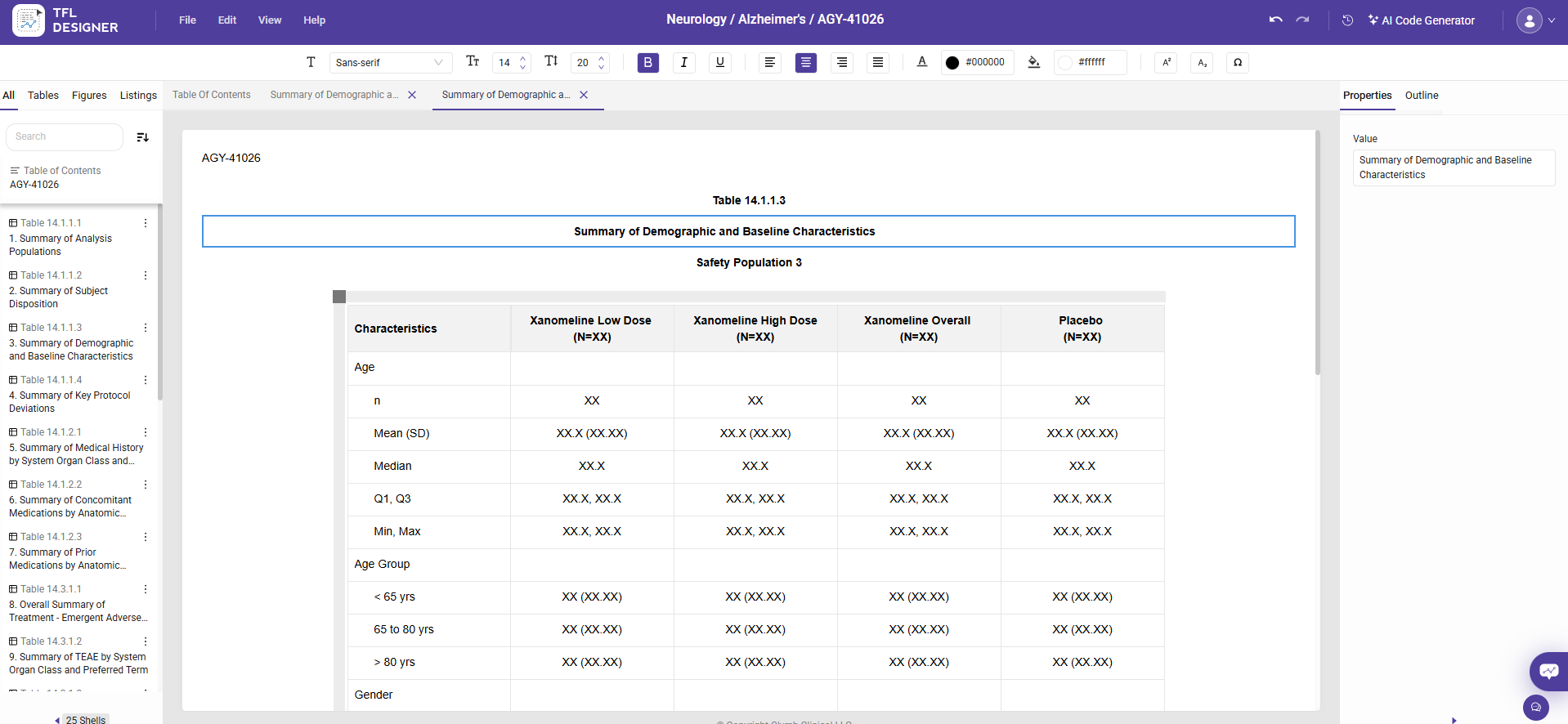
Figure: Table shell in TFL Designer.
You open a shell in TFL Designer, click on AI Code Generator, and ask it to create SAS or R code, either from scratch or using macros. It reads the macro descriptions, consults the CDISC ARS metadata, and fills in every variable needed to generate that table in seconds. What earlier took 30 minutes to an hour is now done before I can even finish making tea.
So how does it work without hallucinating like a daydreaming junior cook?
- Guardrails (custom prompts for AI).
- Structured metadata using the CDISC ARS model.
- Validated TFL Macros and R functions with clear expected input descriptions.
Together, they form a powerful recipe for turbo TFLs.
And what is my job now as a SAS or R programmer?
Simple. Download the program, check it, put my name on top, and run it.
Done.
Just like cooking with a brilliant sous-chef, AI handles the chopping, grinding, and prep work, and I get to add the finishing garnish.
*tadka-Tadka is an Indian cooking method of blooming whole or ground spices in hot oil or ghee to create a flavorful oil mixture that is then added to a dish. It’s also known as “tempering” and is used to finish dishes like lentil soups (dal) and curries, adding a burst of flavor and aroma.
For more info please contact info@clymbclinical.com
Shivani Gupta
Director of Statistical Programming
Latest Blogs
By Tawanna Childs
June 25, 2026
Clymbing Higher
From Midwest Roots to AI-Driven Biotech: Why I Moved to Boston.
I always envisioned trading in the Midwest for endless sunshine, crystal beaches, and tropical blooms. Somehow, my directionally illiterate self-ended up in the East Coast-where winters drag on, the days are shorter, traffic always wins and you quickly begin questioning your life choices.
By Tanaya Kondejkar
June 12, 2026
Beyond the Prompt: AI in Biostatistics, Statistical Programming and Medical Writing Workflow
We are living through a revolution where AI is reshaping how all industries operate. The clinical trial domain is one of the most complex industries but AI is very quickly transforming how the reporting side of it works. Clinical workflows follow strict regulatory standards. As someone building AI systems in this space, I’ve found that […]
By Bhavin Busa
May 21, 2026
AI Pulse: Taking the Industry’s Temperature on GenAI in Statistical Programming
AI Pulse was one of the most talked-about sessions at PHUSE US Connect 2026. Moderated by Bhavin Busa, the session brought together 75+ statistical programming professionals for a candid, anonymous look at where the industry actually stands on GenAI adoption. The results may surprise you...
By Navin Dedhia
April 8, 2026
AI Isn’t Replacing Clinical Programmers – It’s Redefining the Role
There’s growing noise in clinical programming circles. Questions like “Will AI replace clinical programmers?” or “Will R automation eliminate manual TFL programming?” are becoming more common. But these questions miss the point.
By Clymb Clinical
April 8, 2026
Clymb Clinical at PHUSE US Connect 2026
PHUSE US Connect 2026 was one of the most active conference weeks in Clymb Clinical's history. Our team of seven traveled to Austin, Texas to present, exhibit, connect, and compete in the annual 5K Fun Run. Across five days, the Clymb team delivered five technical presentations, hosted two Clymbr Hub Lunch & Learn sessions, and came home with a Best Paper Award. Here is a look at everything that happened.
